Exercise Therapy (KG) at Physiotherapy VITALITY in Frankfurt City Centre
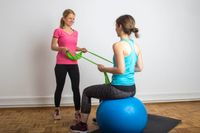
In exercise therapy (KG), your active participation is key: with targeted exercises and practical, everyday strategies, we help you reduce symptoms long-term, improve mobility and build stability.
At VITALITY – Practice for Physiotherapy and Training in Frankfurt city centre, we create a plan that fits your daily life, your goals and your clinical findings.
Do you have a prescription for exercise therapy (KG)?
We guide you in a structured way—from the first assessment to a home exercise routine.
What is Exercise Therapy (KG)?
Exercise therapy improves function and movement quality—primarily through specific, well-dosed exercises. Unlike purely passive treatments (e.g. massage), you learn movements and strategies that help your body become more stable and resilient again.
Common elements of exercise therapy (depending on prescription and findings):
- Mobilisation and improving range of motion (joint function)
- Stability and strengthening exercises (load tolerance)
- Coordination, balance and, if needed, gait training
- Functional training for everyday life, work and sport (e.g. lifting, sitting)
- Breathing and unloading/relief strategies
- Guidance for self-management and a home programme
When is Exercise Therapy helpful?
Exercise therapy is commonly used for:
- Pain and muscle tension (e.g. back and neck pain)
- Joint problems (e.g. knee, hip, shoulder, ankle)
- Limitations after injury or surgery (rehab, progressive return to load)
- Posture and movement issues (e.g. muscular imbalances, unstable movement patterns)
- Recurrent symptoms in daily life or sport (load-related pain, insecurity)
- Coordination/neurological topics (depending on prescription)
Why is KG often especially sustainable?
Exercise therapy aims for long-term improvement because it builds function rather than only providing short-term relief.
Depending on your condition, active therapy can be more effective than passive measures alone—often a combination is possible, but active progress is usually the foundation.
How a KG session works at our clinic
At the start, we take time for assessment and goal setting. We look at your mobility, load tolerance, pain behaviour and the relevant demands from everyday life, work or sport. Based on this, we develop an individual, logically structured approach that builds step by step toward your goal.
Active exercise is at the centre of treatment: you learn targeted exercises and movement strategies that match your symptoms and help you rebuild stability, control and resilience. We adjust the programme as you progress so treatment stays effective and you feel safer and more confident in movement over time.
Prescription, session length & appointments
Exercise therapy (KG) is prescribed by a doctor (public or private—depending on insurance and prescription). If you’re unsure what exactly is written on your prescription, we’re happy to help you interpret it.
We usually schedule 40-minute appointments, because effective therapy needs enough time—not only for treatment, but also for history-taking, a brief reassessment, aligning goals and clear instruction. This leaves sufficient room to work therapeutically in a focused way.
Depending on your condition, your doctor may prescribe Exercise Therapy (KG) and Manual Therapy (MT) together. A session can then be split sensibly—for example 20 minutes MT and 20 minutes KG—so we treat the problem specifically first and then stabilise the result actively right away.
The overall treatment duration depends, among other things, on how many sessions are prescribed and which goals we pursue together.
FAQ – Exercise Therapy (KG)
What’s the difference between KG and Manual Therapy (MT)?
KG is mainly active: you train to build mobility, strength, stability and function. MT is more passive and uses specific hands-on techniques. In many cases, KG is especially sustainable because active training improves long-term load capacity.
Do I need to actively participate?
Yes—your participation is central in most cases for lasting results.
How quickly will I notice improvements?
Many patients feel first changes within a few sessions. Long-term results usually require consistent implementation.
What should I bring to my appointment?
Your original prescription (or send it by email in advance), a towel, comfortable clothing and any relevant reports or previous findings.
👉Back to Services
Request an appointment: Contact Form
VITALITY – Practice for Physiotherapy and Training
Schillerstraße 30–40, 60313 Frankfurt am Main
Tel. +49 69 15343443
Please leave your phone number if you can’t reach us.
 EN
EN DE
DE